America’s Enduring Colonial Mystery
Few stories in early American history are as mysterious as the disappearance of the Roanoke colonists. In 1587, more than one hundred English settlers arrived on Roanoke Island, located along the coast of present-day North Carolina. They came with the intention of establishing a permanent English community in the New World.
Among them were families, craftsmen, soldiers, and children. One of the settlers was Eleanor Dare, the daughter of the colony’s governor, John White. On August 18, 1587, Eleanor gave birth to Virginia Dare, who is generally recognized as the first child of English parents born in the territory that later became the United States.
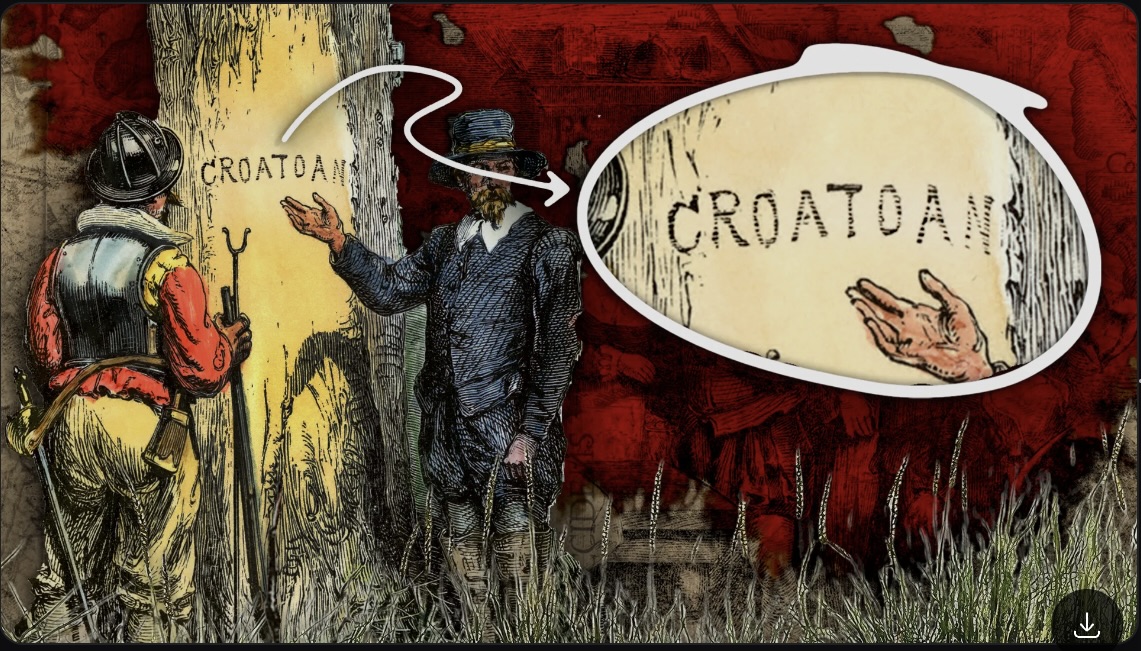
Three years later, when John White returned from England, the settlement had vanished. The houses were gone, the colonists were missing, and no bodies were found. The only significant clue was a word carved into wood: “CROATOAN.”
The fate of the colonists has never been conclusively determined.
England’s Early Colonial Ambitions
The Roanoke colony was part of England’s broader effort to establish a presence in North America. During the sixteenth century, European powers were competing for territory, wealth, trade routes, and political influence. Spain had already built a powerful empire in the Americas, and England wanted to challenge Spanish dominance.
Sir Walter Raleigh received a charter from Queen Elizabeth I allowing him to explore and colonize parts of the North American coast. Raleigh never personally traveled to Roanoke, but he sponsored several expeditions intended to establish an English settlement.
The region was not uninhabited. Roanoke Island and the surrounding coastal areas were home to Indigenous communities with long-established political systems, trade networks, languages, agricultural practices, and knowledge of the environment. The English settlers entered a populated and complex world rather than an empty wilderness.
The First Roanoke Settlement
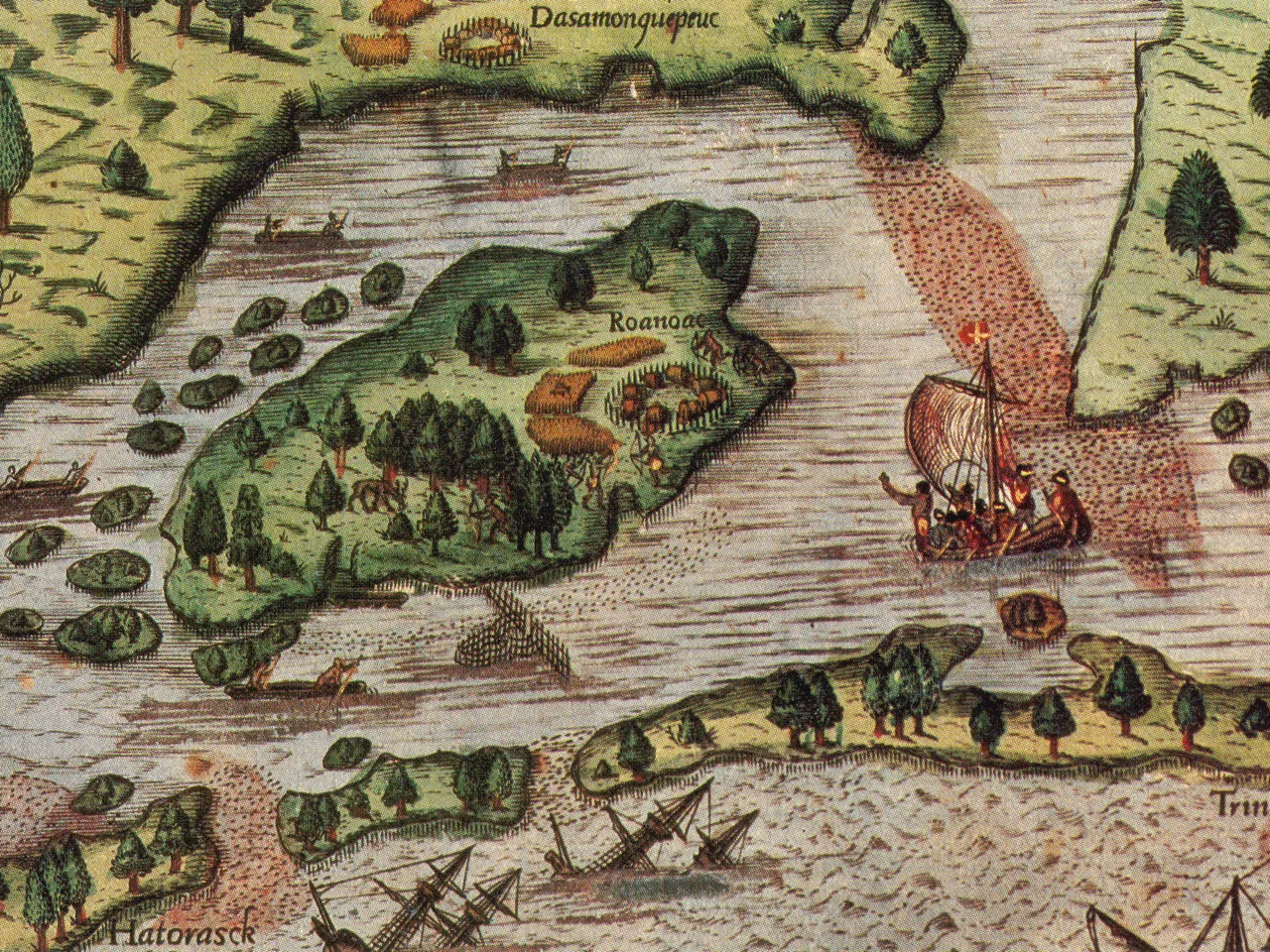
The first English settlement on Roanoke Island was established in 1585. This expedition included soldiers, craftsmen, scientists, and artists. Among the most important members were John White, who created detailed watercolors of the region, and Thomas Harriot, who studied the land, plants, animals, and Indigenous communities.
White’s paintings are among the most valuable surviving visual records of early English encounters with the North American coast. They depict Indigenous people, villages, clothing, food, tools, and landscapes. Harriot also documented the natural resources and agricultural practices of the region.
Despite these efforts, the settlement struggled. The colonists depended on supplies from England and faced serious challenges involving food, disease, weather, unfamiliar terrain, and relationships with nearby Indigenous communities.
In 1586, Sir Francis Drake encountered the settlement while returning from military campaigns in the Caribbean. Many of the colonists accepted his offer to return to England. The first settlement was abandoned, although a small group of Englishmen remained behind.
The 1587 Colony
A second expedition was organized in 1587. This group was different from the first because it included families and civilian settlers who hoped to build a permanent community.
John White served as governor. The group consisted of approximately 117 men, women, and children. Their intended destination was not originally Roanoke Island, but the Chesapeake Bay region. The settlers were supposed to establish a colony farther north, where they believed conditions might be more favorable.
However, the expedition’s pilot refused to take them farther. The colonists were left on Roanoke Island instead, even though the previous settlement had already been abandoned.
This decision placed the new community in a difficult position. The settlers had limited supplies, no immediate reinforcements, and an uncertain relationship with neighboring Indigenous groups. They were also separated from England by thousands of miles of ocean.
The Birth of Virginia Dare
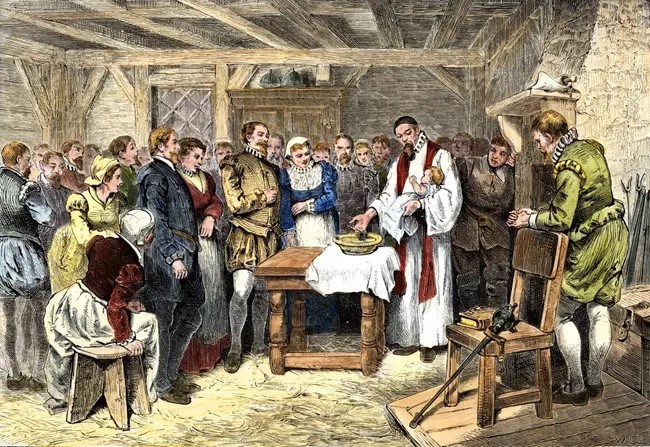
On August 18, 1587, Eleanor Dare gave birth to a daughter named Virginia Dare. Her birth occurred only a few weeks after the colonists arrived on Roanoke Island.
Virginia Dare became an important figure in American history because she was the first child of English parents known to have been born in the territory that later became the United States. Her life, however, is almost entirely unknown. No reliable record describes what happened to her after the colony disappeared.
Virginia was not the only child in the settlement. Other children were also part of the colony, which makes the mystery especially tragic. The settlement was not simply a military outpost; it was a community containing families who had traveled across the Atlantic in the hope of beginning new lives.
John White Returns to England
The colonists soon recognized that they needed more supplies. John White agreed to return to England to obtain food, tools, weapons, and additional support.
White intended to come back quickly. Before leaving, he made an agreement with the settlers. If they moved from Roanoke Island, they were supposed to carve the name of their destination into a tree or post. If they were forced to leave because of danger, they were expected to carve a cross above the message.
White sailed to England in 1587, expecting to return within a short period. Instead, his return was delayed by events in Europe.
England was preparing for war with Spain. In 1588, the Spanish Armada threatened England, and English ships were needed for military defense. Ships and supplies that might otherwise have supported the Roanoke colony were redirected toward the conflict.
White was unable to return to North America for approximately three years.
The Colony Without Support
During White’s absence, the colonists had no reliable way to communicate with England. They could not send regular letters or request supplies. Their survival depended on what they could produce, trade, gather, or obtain from surrounding communities.
The settlers faced many possible dangers. Food shortages could have become severe. Storms and disease could have affected the population. Relations with Indigenous communities may have changed over time. Some colonists could also have died or abandoned the settlement in search of better conditions.
The absence of records from this period is one of the central reasons the mystery remains unresolved. No surviving document clearly explains how the colony lived, whether it divided into groups, or where its members traveled.
White’s Return in 1590
John White finally returned to Roanoke Island in August 1590. He expected to find the settlement and reunite with his daughter, granddaughter, and the other colonists.
Instead, he found the settlement deserted.
The buildings had been dismantled or removed. There was no evidence of a large battle. No bodies were discovered, and no message explained what had happened. The colonists had disappeared as an organized community.
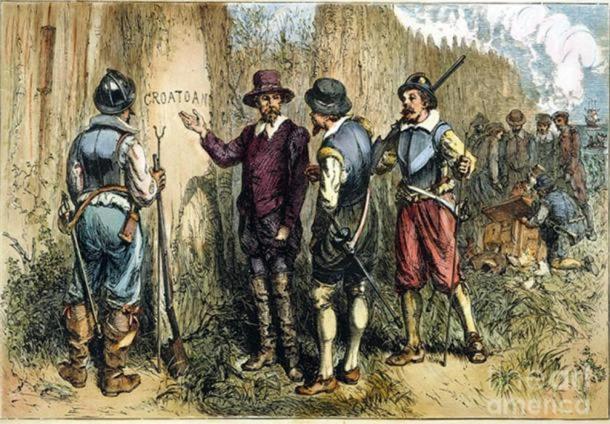
White searched the settlement for clues. He found the letters “CRO” carved into a tree. Later, he discovered the more complete word “CROATOAN” carved into another location.

What Did “CROATOAN” Mean?
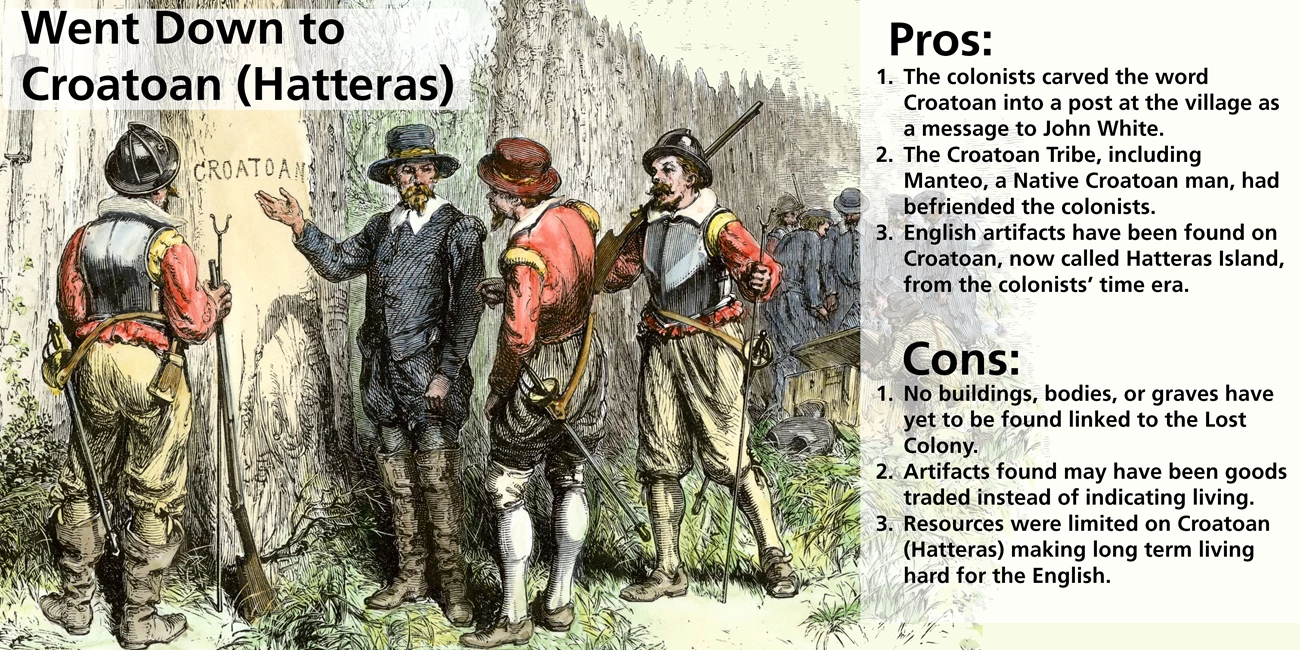
Croatoan was the name of an Indigenous community and the name associated with an island south of Roanoke, now generally connected with Hatteras Island.
White understood the word to mean that the colonists had moved to Croatoan. He was encouraged by the fact that no cross had been carved above the message. According to the agreement he had made with the settlers, the absence of a cross might have meant that the colonists had left voluntarily rather than under immediate threat.
However, White was never able to conduct a complete search. Bad weather disrupted the expedition, and the ships were forced to leave the area.
The word “CROATOAN” is therefore an important clue, but it is not a complete explanation. It does not tell historians whether all of the colonists moved there, whether only some of them went there, or what happened after they arrived.
The Main Theory: Relocation to Croatoan
The most straightforward explanation is that the colonists relocated to Croatoan Island or joined the Croatoan community.
The settlers had agreed that they might move if necessary. Croatoan was also associated with Indigenous people who had interacted with earlier English expeditions. The colonists may have believed that moving south would provide better access to food, shelter, and local knowledge.
Some English objects were later reported or discovered in areas associated with Indigenous communities. These findings have encouraged the theory that at least some of the colonists survived and integrated into neighboring communities.
However, individual European objects do not prove that the entire colony relocated to one place. Items could have been traded, carried by travelers, or obtained through contact with English ships and other settlements.
The Possibility of Multiple Destinations
Another possibility is that the colonists divided into smaller groups.
A settlement of more than one hundred people may have been difficult to support in one location. The colonists might have moved gradually, with different groups traveling to different Indigenous communities or settlements.
The word “CROATOAN” may have referred to the general direction of one group rather than the final location of every colonist. Some settlers may have gone south, while others may have traveled inland or north toward the Chesapeake region.
If the colony divided in this way, it would explain why later searches failed to find one large English settlement. A dispersed population would have been much more difficult to locate.
Disease, Hunger, and Environmental Hardship
The colony may also have been weakened by hunger, disease, and environmental difficulties.
Roanoke Island was not necessarily the ideal location for a large English settlement. The colonists arrived with limited knowledge of local growing seasons, weather patterns, and food sources. Their ability to survive depended on agriculture, hunting, fishing, and trade.
The Outer Banks region is also exposed to powerful storms and changing coastal conditions. Hurricanes may have damaged buildings, destroyed supplies, or altered the landscape.
Some colonists may have died from illness or starvation. Others may have left the settlement after recognizing that remaining there was no longer practical.
This explanation does not necessarily conflict with the relocation theory. It is possible that some settlers died while others survived and moved elsewhere.
The Possibility of Conflict
Conflict with Indigenous communities is another theory that has been considered. Relations between the English and Indigenous peoples were not uniform. Some communities traded with the colonists, while others opposed the English presence.
The first Roanoke expedition experienced serious tensions with local communities. In one well-known incident, the English killed an Indigenous leader named Wingina, who was also known as Pemisapan. Such actions likely contributed to distrust and hostility.
However, there is no conclusive evidence that the entire 1587 colony was destroyed in a single attack. White’s discovery of the word “CROATOAN” and the absence of clear signs of a battle have made a complete massacre less certain than popular retellings sometimes suggest.
Archaeological Investigations
Archaeologists have spent decades searching for evidence of the colonists. Excavations have uncovered English artifacts in the Roanoke region, including fragments of ceramics, metal objects, and other materials associated with sixteenth-century European activity.
These discoveries are important, but they are difficult to interpret. An artifact may show that English people visited a particular location, but it does not automatically prove that the entire Lost Colony lived there.
The coastal landscape has also changed significantly since the sixteenth century. Storms, erosion, rising water levels, shifting shorelines, vegetation, and later development may have destroyed or concealed evidence.
Some researchers believe that portions of the settlement or later migration routes may now lie beneath sediment or water. This makes archaeological work especially challenging.
The “Dare Stones”
One of the most controversial pieces of evidence connected with Roanoke is a group of stones known as the Dare Stones.
The first Dare Stone appeared in 1937. It contained an inscription claiming to describe the fate of Eleanor Dare and the colonists. Additional stones later appeared, but most historians and researchers consider them fraudulent.
The stones became famous because they seemed to provide a dramatic explanation for the colony. However, problems with their language, discovery, history, and authenticity have led experts to reject them as reliable evidence.
The Dare Stones are an important example of why historical mysteries must be investigated carefully. An object can appear convincing while still lacking trustworthy origins or independent verification.
Why the Mystery Became So Famous
The Roanoke story became more famous because it contained several powerful elements: a remote island, a vanished community, a newborn child, a missing governor’s family, and a single mysterious word.
The story also developed during a period when information traveled slowly. News about the colony was incomplete, delayed, and often mixed with speculation. Later generations filled in the gaps with stories of kidnapping, warfare, secret journeys, and survival among Indigenous communities.
Over time, the phrase “Lost Colony” became more influential than the limited historical record. It encouraged people to imagine a single dramatic disappearance, even though the colonists may have moved gradually or divided into groups.
What Is Known for Certain?
Although many questions remain unanswered, several facts are well established.
The 1587 expedition arrived on Roanoke Island under John White’s leadership. The group included families and children. Eleanor Dare gave birth to Virginia Dare on August 18, 1587. John White left for England to obtain supplies. His return was delayed for approximately three years. When he returned in 1590, the settlement was abandoned.
The word “CROATOAN” was found carved at the site. No definitive record explains what happened to the colonists afterward.
Beyond these facts, historians must distinguish between evidence, reasonable interpretation, and speculation.
Has the Lost Colony Been Found?
No conclusive discovery has solved the mystery.
Several archaeological sites have produced evidence connected to early English activity, but researchers have not identified a single location containing unmistakable evidence of the entire 1587 colony.
The most plausible explanation may involve several events rather than one. Some colonists may have moved to Croatoan. Others may have traveled inland or joined different communities. Some may have died from disease, hunger, conflict, or other hardships.
It is also possible that the colonists survived for a time but eventually lost their English identity as they became part of Indigenous communities. If that happened, later English search parties may have failed to recognize them as members of the original colony.
The Lasting Legacy of Roanoke
The Lost Colony of Roanoke remains important not only because it is mysterious, but because it reveals the extreme difficulty of England’s early colonial ambitions.
The settlers were attempting to create a permanent community thousands of miles from home. They faced an unfamiliar environment, limited supplies, unreliable communication, international conflict, and complicated relationships with Indigenous societies.
Their story also reminds us that historical evidence is often incomplete. The absence of records does not mean that nothing happened. It means that historians must reconstruct the past from fragments: maps, artifacts, inscriptions, environmental evidence, Indigenous histories, and contemporary accounts.
Conclusion
The Lost Colony of Roanoke has never been conclusively explained. The word “CROATOAN” strongly suggests that at least some of the settlers may have moved toward the community or island associated with that name, but the evidence does not establish the fate of every colonist.
The settlers may have relocated, divided into groups, joined Indigenous communities, died from hardship, or experienced several of these outcomes at once.
What makes Roanoke so compelling is not that the past offers no clues. It is that the clues are incomplete. The colonists left behind enough evidence to prove that they lived, traveled, and attempted to establish a community, but not enough to tell us exactly how their story ended.
Until new archaeological or documentary evidence is discovered, the fate of the Roanoke colonists will remain one of early America’s most enduring historical mysteries.
Image sources include the National Park Service, Encyclopaedia Britannica, Wikimedia Commons, and archaeological and historical publications. Image rights should be verified before republication or commercial use.