Venice’s Liquid Heart
There are cities that reveal themselves by their streets, cities that unfold through plazas and avenues, and then there is Venice—a city that must be read upon water.
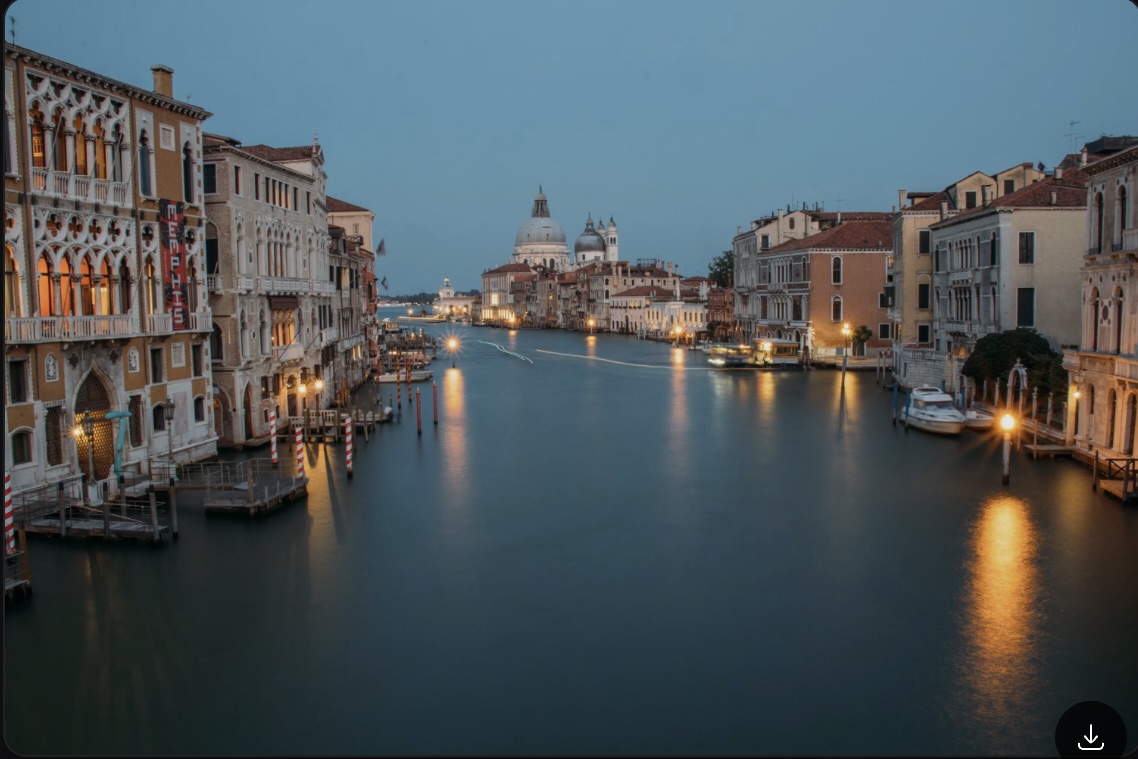
At the center of it all lies the Grand Canal, the broad, curving artery that winds through Venice like a stroke of blue ink. It is not merely a waterway. It is Venice’s main street, its stage, its mirror, and its memory. Along its banks rise palaces built by merchants, churches shaped by devotion, and centuries-old façades whose faded colors seem to deepen rather than diminish with age.
To travel along the Grand Canal is to move through a living painting. The city does not pass by in a sequence of ordinary buildings. It appears in layers: a Gothic arch beside a Renaissance window, a weathered balcony above a flower-filled terrace, a quiet doorway opening directly onto the water. Every turn offers another composition, and every reflection seems to tell a second story beneath the first.
A city shaped by water
Venice was born from a daring act of imagination. Built across a lagoon on hundreds of small islands, the city transformed an unstable landscape into one of the most extraordinary urban environments in the world. Water became its road, its defense, its marketplace, and eventually its defining language.
The Grand Canal follows the shape of a great inverted “S” through the heart of the city. Unlike a river, it has no obvious source or destination within Venice. It simply flows as the city flows, bending around neighborhoods and palaces before opening toward the lagoon.
For centuries, boats have carried nearly everything along its surface: merchants and nobles, artists and travelers, fishmongers and furniture makers. Even today, the water remains busy with vaporetti, gondolas, water taxis, delivery boats, and small craft that seem to know the canal’s shifting currents by instinct.
From the water, Venice feels less like a collection of buildings and more like a single, continuous presence. Its walls rise directly from the canal, their foundations hidden below the surface. The city appears to float, although its history is anchored deeply in the mud, stone, and timber beneath it.
Palaces reflected in the tide

Many of the buildings display the characteristic elegance of Venetian Gothic architecture: pointed arches, delicate tracery, slender columns, and windows arranged almost like lace. Others carry the order and balance of the Renaissance, or the theatrical exuberance of the Baroque. Together, they form an architectural conversation across the water.
Yet the charm of the Grand Canal lies not only in its most celebrated palaces. It is also found in the small details: shutters that have softened under the sun, green algae at the waterline, laundry moving gently above a narrow balcony, and carved stone worn smooth by countless seasons.
Venice has never been a city that keeps its age hidden. Its beauty is inseparable from its weathering. Paint peels. Marble darkens. Brick reveals itself beneath plaster. In another city, such marks might suggest neglect. Along the Grand Canal, they feel like evidence—a visible record of time.
The Rialto and the pulse of commerce
Near the center of the canal stands the Rialto Bridge, one of Venice’s most recognizable landmarks. Its pale stone arch spans the water with a graceful confidence, connecting two historic districts and carrying a constant stream of footsteps above the boats below.
The Rialto has long been associated with trade. Markets flourished nearby, and the surrounding streets became a center of commerce where goods from across the Mediterranean entered the city. The Grand Canal was the route by which Venice met the wider world.
Even now, the area retains something of that old energy. Boats unload supplies along the banks. Vendors arrange produce beneath striped awnings. Visitors pause on the bridge to watch the traffic below, while locals cross with the purposeful stride of people who have somewhere to be.
The bridge is often crowded, but the view from it remains unforgettable. Looking along the canal, one sees water folding into the distance between rows of palaces. Gondolas slide beneath the arches. The surface gathers the colors of the buildings—ochre, rose, cream, and faded green—and breaks them into trembling ribbons.
Santa Maria della Salute: a vision at the water’s edge

Its great dome is one of the essential images of Venice. Seen from a distance, it seems to balance between earth and sky, its pale stone illuminated by the changing light. The church was built as a votive offering after the plague, and its very presence expresses both grief and gratitude.
The Salute is especially beautiful in the early morning, when the canal is quiet and the city’s sounds have not yet gathered strength. The basilica’s steps descend toward the water, and the entire building appears to stand at the threshold between the human world and the lagoon.
At sunset, the scene changes completely. The stone warms to gold, the shadows lengthen across the façades, and the dome catches the final light of day. Boats pass in silhouette. The water becomes a field of copper and violet. For a moment, Venice seems less like a place inhabited by people than a dream remembered by the sea.
The rhythm of a journey by boat
The best way to understand the Grand Canal is to travel along it slowly.
A vaporetto offers the most democratic view. Passengers stand or sit together—residents, students, workers, visitors—and watch Venice drift past at the pace of the water. The journey is practical, but it is also cinematic. A church appears, disappears, and then returns from another angle. A palace turns its façade toward the canal. A small side passage opens briefly before vanishing behind a wall.
A gondola offers a quieter experience. Its movement is almost impossibly smooth, guided by the measured strokes of the gondolier. From the low seat of the boat, the perspective changes: the palaces seem taller, the bridges more dramatic, and the surface of the canal close enough to touch.
But the Grand Canal does not require a boat to be experienced. It can be watched from a bridge, a waterside terrace, or a quiet landing at the edge of a narrow street. It can be heard before it is seen—the slap of water against stone, the distant hum of an engine, the call of a boatman echoing beneath an arch.
Venice rewards stillness. If one stops rushing, the canal begins to reveal its quieter details.
Morning, when Venice belongs to itself

The crowds have not arrived. Delivery boats move through the dim light, carrying bread, vegetables, flowers, and the necessities of daily life. The façades stand quietly above the water, their windows still dark. Mist may hover over the lagoon, softening the outlines of distant buildings.
This is the hour when Venice feels most intimate. The city is no longer a monument being admired; it is a place waking up. A shopkeeper lifts a shutter. A fisherman checks his lines. Someone leans from a balcony to call across the water.
The Grand Canal has always been both spectacular and ordinary. It has witnessed triumphs, ceremonies, celebrations, and processions, but it has also carried the unremarkable cargo of everyday life. Its greatness does not erase its practicality. The canal is beautiful because it is still used, still crossed, still woven into the habits of those who live beside it.
Evening, when the water becomes a mirror
As evening descends, the Grand Canal begins to hold the colors of the sky.
The pale façades take on shades of amber and rose. Windows glow one by one. The water darkens, but it does not become empty; instead, it gathers the reflected lights of the city and carries them away in broken, shimmering trails.
This is when Venice seems to suspend time. The sound of traffic becomes softer. Conversations drift from open windows. The wake of a passing boat spreads beneath the reflections, distorting the palaces into wavering towers of light.
There is something deeply moving about seeing a city reflected in water. Reflections are never exact. They tremble, stretch, and disappear. They remind us that beauty is temporary—not because it is fragile, but because it is always changing.
The Grand Canal is never quite the same twice. Its appearance depends on the hour, the tide, the weather, and the season. Morning gives it silver. Noon gives it blue. Sunset gives it gold. Rain makes the stone shine. Fog turns architecture into suggestion.
A fragile masterpiece
The splendor of the Grand Canal is accompanied by an awareness of vulnerability. Venice has always lived with water, but the relationship has become more precarious as the city faces rising seas, flooding, erosion, and the pressures of mass tourism.
The canal’s buildings are remarkable precisely because they have endured so much. Their foundations, protected and challenged by the lagoon, have carried centuries of weight. The city’s future depends on preserving not only its monuments but also its living character.
To care for Venice is to understand that it is not simply an open-air museum. It is a home. The Grand Canal is not a decorative feature placed in front of a historic city; it is the city’s central system of movement and life.
Its preservation therefore requires more than admiration. It requires patience, thoughtful stewardship, and respect for the people who continue to inhabit its islands. The canal must remain a place where daily life can continue, not merely a beautiful backdrop for photographs.
The memory of water

The Grand Canal is the clearest expression of that impossibility.
It is a road without dust, a river without a source, and a mirror that has reflected generations of human life. It carries the sound of oars and engines, the shadows of bridges, the colors of palaces, and the changing light of the sky.
To stand beside it is to feel the movement of history without being separated from the present. The past is not locked away here. It passes continually before the eyes, borne along by the tide.
And perhaps that is the true enchantment of the Grand Canal: it teaches us that a city can be both permanent and fleeting. Its buildings endure, but their reflections vanish. Its waters return, but never in exactly the same form. Every journey along the canal is therefore a kind of farewell—and an invitation to look once more.
Final reflection
The Grand Canal is Venice’s liquid heart, beating beneath bridges and beside palaces, carrying the city’s stories toward the lagoon.
It is most magnificent when viewed from a moving boat, but it is just as powerful when encountered unexpectedly: at the end of a narrow alley, through a half-open doorway, or from a bridge where the evening light has turned the water into glass.
Venice does not ask to be conquered or hurried through. It asks to be observed.
And if you give the Grand Canal enough time, it offers something rare: not simply a beautiful view, but the feeling of entering a world that has learned to live between land and water, memory and motion, history and dream.