Patagonia’s Cathedral of Wind, Ice, and Stone
Some people have had the privilege of witnessing such beauty in their lives, and some of us can only hope that one day we could walk this side of the Earth. This jaw dropping awesome place that could only be described as gorgeous is called Torres del Paine, it is a breathtaking national park in Chilean Patagonia, famous for its towering granite peaks, turquoise lakes, ancient glaciers, and wild landscapes. It is a perfect destination for adventurers seeking unforgettable scenery and the raw beauty of nature.
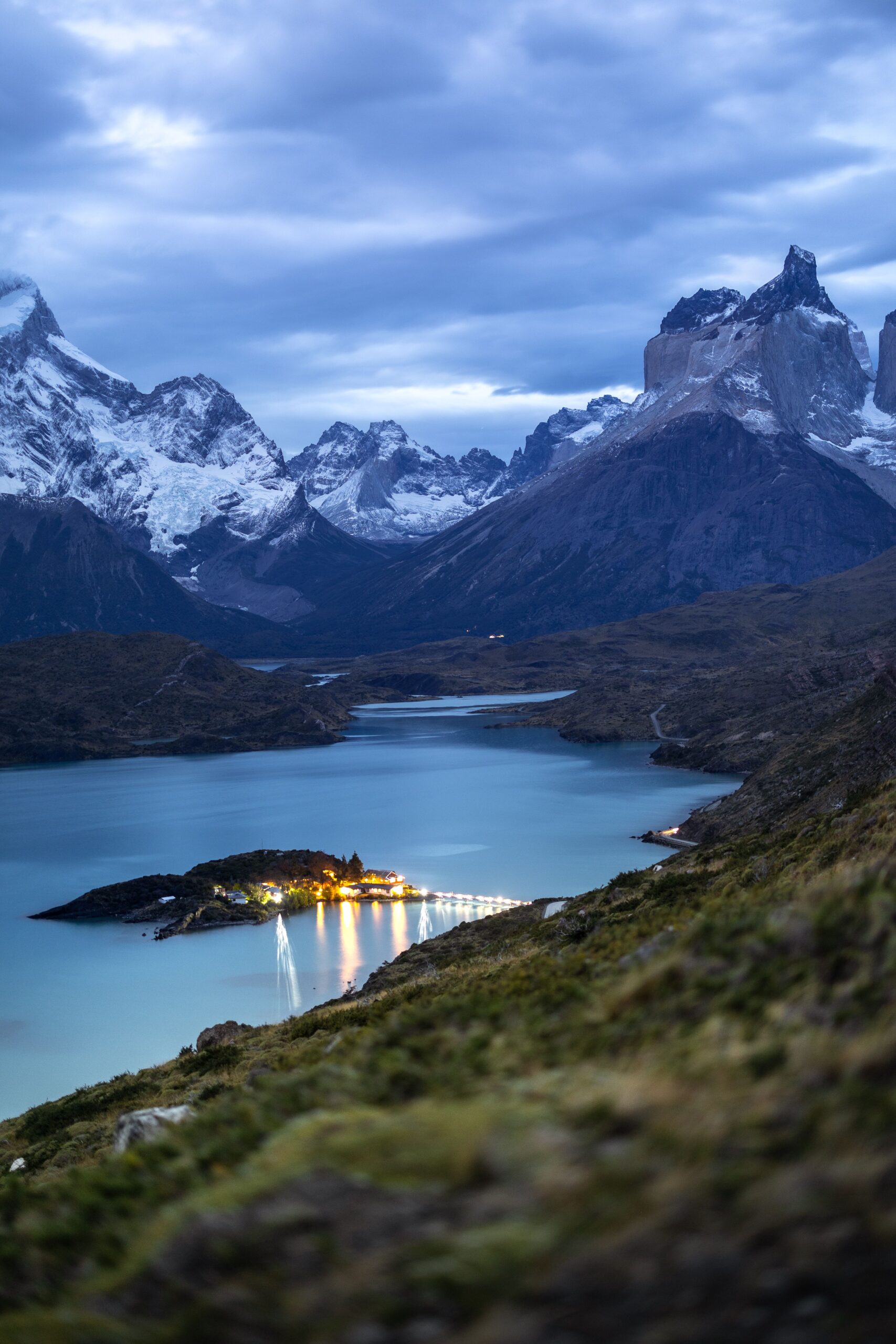
At the far southern edge of Chile, where the continent begins to dissolve into islands, glaciers, fjords, and endless ocean, Torres del Paine National Park rises like a natural fortress. Its landscape is immense and dramatic: pale granite towers point toward the sky, turquoise lakes stretch beneath snow-covered mountains, rivers rush across open plains, and glaciers descend from the Southern Patagonian Ice Field.
The wind moves constantly through the valleys. Clouds gather around the peaks, disappear, and return minutes later. Sunlight passes across the land in shifting patches, turning the same mountain from silver to gold, from blue to violet, and finally to black against the evening sky.
Torres del Paine is not a place that reveals itself all at once. It is a landscape of changing moods. One moment, the mountains appear calm and distant. The next, they seem enormous and almost alive.
This is Patagonia at its most powerful: remote, unpredictable, breathtaking, and unforgettable.
Where Is Torres Del Paine?
Torres del Paine National Park is located in Chilean Patagonia, in the Magallanes and Chilean Antarctica Region of southern Chile.
The park lies between the Andes Mountains and the wide Patagonian steppe. Its name comes from two important features:
- Torres, meaning “towers” in Spanish, refers to the three immense granite spires that dominate one of the park’s most famous viewpoints.
- Paine is generally associated with the Tehuelche language and is often interpreted as meaning “blue,” a reference to the brilliant color of the park’s lakes, rivers, and skies.
The park covers approximately 242,000 hectares and contains an extraordinary variety of landscapes within a relatively compact region. Visitors can encounter ancient forests, open grasslands, wetlands, glacial valleys, rocky mountains, waterfalls, lakes, rivers, and ice fields.
In 1978, UNESCO designated Torres del Paine a World Biosphere Reserve, recognizing its international importance as a place where conservation, scientific study, local communities, and sustainable tourism could coexist.

A landscape created by ice, fire, and time
The mountains of Torres del Paine were formed over millions of years through powerful geological processes.
The park’s most recognizable peaks are composed largely of granite. Deep beneath the surface, molten rock slowly cooled and hardened. Over immense periods of time, layers above the granite were eroded away, gradually exposing the rock.
Glaciers then shaped the mountains further.
Moving slowly under their own weight, glaciers cut valleys, polished cliffs, widened basins, and carried enormous quantities of stone. The broad valleys and deep lakes visible today are part of this long process.
The landscape is still changing. Glaciers continue to retreat and advance in response to changing climate patterns. Rivers carry sediment away from the mountains. Rockfalls alter cliffs and slopes. Wind and weather constantly reshape the exposed terrain.
Torres del Paine may appear permanent, but it is actually a living geological story.
The towers themselves are not simply mountains. They are the visible remains of ancient rock transformed by time, ice, water, and temperature.
The first people of Patagonia
Long before Torres del Paine became a national park, this region was known and traveled by Indigenous peoples.
The broader Patagonian landscape was home to communities including the Tehuelche, also known as the Aónikenk. These peoples traveled across the open steppe, adapting to one of the most demanding environments on Earth.
The plains, valleys, rivers, and mountains were not separate worlds. They were part of a connected landscape used for travel, hunting, gathering, trade, and cultural life.
The Tehuelche were highly skilled at moving across vast distances. Their understanding of seasonal patterns, animal behavior, weather, and geography allowed them to live in an environment where resources could be scattered and conditions could change rapidly.
The arrival of Europeans and later settlers brought profound disruption. Disease, land loss, violence, and government policies severely affected Indigenous populations throughout Patagonia.
Like many protected landscapes around the world, Torres del Paine has a history that includes both conservation achievements and the displacement of people whose relationship with the land began long before the park existed.
Understanding the park requires respect for this deeper history. It is not an empty wilderness. It is a place with human memory, cultural meaning, and stories older than modern borders.
From remote frontier to national park
European explorers and cartographers began documenting the southern Chilean landscape more extensively during the nineteenth century.
Exploration was difficult. Patagonia’s climate, distance, strong winds, and rugged terrain made travel demanding. Rivers and mountains formed natural barriers, while weather could change quickly and without warning.
During the late nineteenth and early twentieth centuries, settlers, ranchers, explorers, and scientists entered the region. Sheep ranching became especially important across the Patagonian steppe.
The relationship between ranching and the national park was complicated. Some areas that are now protected wilderness were once used for livestock and agricultural activity. Remains of fences, trails, buildings, and other structures can still be found in parts of the region.
Torres del Paine National Park was formally established in 1959, although the boundaries and official name changed over time. The creation of the park reflected Chile’s growing interest in preserving its extraordinary southern landscapes.
As roads, transportation, and tourism developed, the region gradually became more accessible. What had once been known mainly to Indigenous travelers, ranchers, scientists, and explorers began to attract hikers and visitors from around the world.
The park eventually became one of the most famous wilderness destinations in South America.
The three granite towers
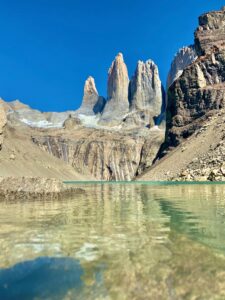
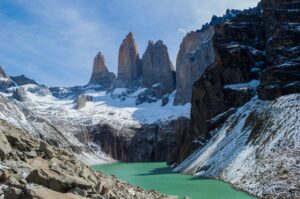
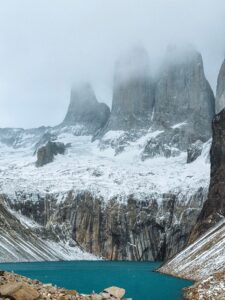
 The park’s most iconic feature is the group of three granite towers known as the Torres del Paine.
They rise dramatically above a valley, forming a composition that seems almost too precise to be natural. Their vertical walls are exposed to wind, snow, ice, and changing light. In the early morning, the towers can glow rose-colored as the first sunlight touches their faces.
The hike to the base of the towers is one of the most famous treks in Patagonia. The trail passes through forests, open valleys, rocky slopes, and steep terrain before reaching a glacial lagoon beneath the towers.
The final viewpoint is often described as a reward for the journey, but the hike is valuable long before the destination. The changing landscape reveals the scale of the mountains gradually. At lower elevations, trees and hills dominate the view. As the trail rises, the valley opens and the granite towers begin to appear.
At the top, the towers seem to stand in silence above the water.
Their presence is overwhelming, but not because they are the tallest mountains in the world. They are powerful because of their shape, isolation, and verticality. They rise like pillars at the end of a natural sanctuary.
The Cuernos del Paine
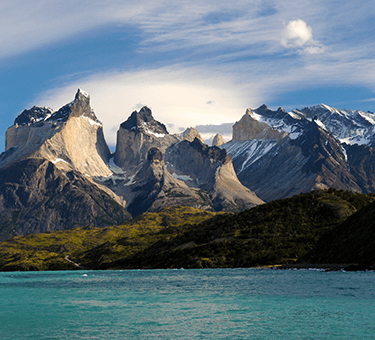
Another defining feature of the park is the group of peaks known as the Cuernos del Paine, or “Horns of Paine.”
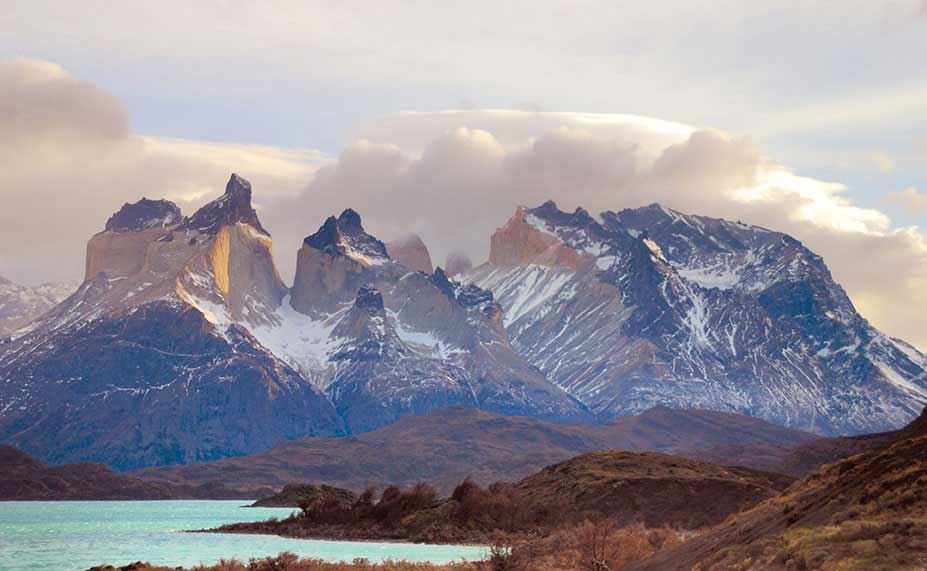
Unlike the smooth vertical towers, the Cuernos have sharply contrasting layers of dark and light rock. Their unusual shapes resemble enormous horns rising above the surrounding valleys and lakes.
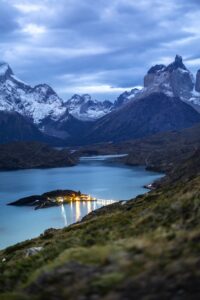
The peaks appear particularly dramatic from the shores of Lake Pehoé, Lake Nordenskjöld, and other viewpoints along the park’s trails.
The dark rock is often associated with sedimentary layers, while the lighter sections reveal the granite beneath. The contrasting bands give the mountains a distinct visual identity, making them instantly recognizable.
Depending on the weather, the Cuernos can look completely different from one hour to the next. Morning mist may hide their lower slopes. Afternoon sunlight can illuminate the upper rock faces. Storm clouds may surround them with deep shadows.
In Torres del Paine, weather is not merely an inconvenience. It is part of the scenery.
The famous Patagonian wind
The wind is one of the defining experiences of Torres del Paine.
Patagonia is famous for powerful winds that sweep across the open plains and accelerate through mountain passes. Gusts can arrive suddenly, pushing against hikers, bending trees, rippling lakes, and carrying clouds across the sky.
The wind has shaped the park’s vegetation. Trees often grow with branches angled in a single direction, a natural formation sometimes called “flag trees.” Their unusual shapes reveal the constant force of the weather.
For visitors, the wind can be exhilarating and exhausting at the same time. It makes the landscape feel alive. It reminds people that they are in an environment where nature sets the rules.
The wind also creates a constantly changing atmosphere. A quiet lake may become covered in ripples within seconds. A mountain obscured by clouds may suddenly appear in brilliant sunlight. A calm trail can become difficult when exposed to a powerful gust.
This unpredictability is part of Torres del Paine’s character.
The park cannot be rushed or controlled. It must be experienced with patience and respect.
Lakes of impossible color
Torres del Paine is home to numerous lakes, lagoons, rivers, and glacial waterways.
Their colors range from deep blue and turquoise to silver, green, and gray. The variation comes from geology, glacial sediment, sunlight, depth, weather, and the surrounding landscape.
Lake Pehoé is especially famous for its vivid blue-green water and exceptional views of the Cuernos del Paine. Lake Nordenskjöld lies beneath dramatic mountain peaks and is often photographed from trails running along its shoreline.
Grey Lake, or Lago Grey, is connected to the Grey Glacier. Large pieces of blue ice sometimes break away from the glacier and float across the water. Against the dark mountains, these fragments appear like floating sculptures.
The lakes are beautiful, but they also reveal the movement of the park’s glaciers. The water carries particles of finely ground rock, which scatter sunlight and create the distinctive colors associated with glacial lakes.
Grey Glacier: a river of ancient ice
Grey Glacier is one of the most remarkable features of Torres del Paine.
It flows from the Southern Patagonian Ice Field, one of the largest expanses of ice outside Antarctica and Greenland. The glacier moves slowly through the mountains, carrying rock, shaping valleys, and feeding lakes and rivers.
From a distance, Grey Glacier appears as a vast wall of blue-white ice. Up close, its surface reveals deep cracks, ridges, shadows, and shades of blue created by the compression of ancient snow.
The blue color of glacial ice occurs because dense ice absorbs most colors of visible light while reflecting blue wavelengths. In a glacier, this blue can appear intense and almost luminous.
Icebergs that break away from the glacier drift across Grey Lake. Their shapes change as they melt, and their surfaces catch the light in different ways.
The glacier is also a reminder of environmental change. Like glaciers in many parts of the world, Grey Glacier has been affected by rising temperatures and changing precipitation patterns. Its condition is not only a local concern; it is part of a much larger global story.
To see a glacier is to see time made visible.
The ice may have formed from snow that fell hundreds or even thousands of years ago. Each layer contains a fragment of climatic history.
The mountain and glacier landscape of Torres del Paine
Valleys, waterfalls, and rivers
The park’s mountains are connected by broad valleys filled with rivers, wetlands, forests, and grasslands.
The Paine River flows through the region, linking lakes and carrying glacial meltwater across the landscape. Waterfalls appear throughout the park, especially where rivers descend from higher basins.
One of the best-known is Salto Grande, a powerful waterfall connecting Lake Nordenskjöld with Lake Pehoé. The water roars through the channel while the Cuernos rise in the distance.
The valleys also provide important habitat for wildlife. Guanacos move across open grasslands, while foxes and pumas follow the movements of prey. Birds circle above the cliffs and wetlands.
These open spaces create some of the park’s most memorable views. Unlike the narrow valleys of many mountain regions, parts of Torres del Paine open widely toward the horizon. Mountains rise on every side, but the land between them remains expansive.
This combination of enclosure and openness gives Patagonia its distinctive sense of scale.
The wildlife of Torres del Paine
Torres del Paine is home to an extraordinary variety of wildlife.
The most visible large animal is often the guanaco, a relative of the llama and alpaca. Guanacos move across the grasslands in herds and are remarkably well adapted to the harsh Patagonian climate.
Their presence is especially important because they form part of the food web supporting the park’s pumas. Torres del Paine is known for its puma population, and the animals have become a symbol of the park’s wild character.
Pumas are elusive, powerful, and difficult to see. They move quietly through the landscape, often avoiding people. Their survival depends on healthy populations of prey and the protection of large, connected habitats.
Other animals found in and around the park include:
- South American gray foxes
- Andean condors
- Black-chested buzzard eagles
- Rheas
- Magellanic woodpeckers
- Chilean flamingos
- Armadillos
- Skunks
- Deer
- Wild horses
- Various ducks and waterbirds
The condor is especially impressive. With its enormous wingspan, it can glide for long distances on rising air currents above the valleys.
Wildlife encounters in Torres del Paine should always be approached carefully. Animals need space, and visitors are responsible for avoiding sudden movements, feeding, approaching, or interfering with them.
The park is not a zoo. It is a functioning ecosystem.
The puma and the meaning of wilderness
The puma has a special place in Torres del Paine.
For many visitors, the possibility of seeing one becomes a central part of the journey. Yet the importance of the puma is greater than its value as a photographic subject.
The puma represents the existence of a healthy, functioning food chain. Where pumas can survive, there must be sufficient prey, connected habitats, shelter, and relatively low levels of human disturbance.
Their presence reminds us that wilderness is measured not only by scenery, but by the survival of species that require space and freedom.
A puma may cross a valley without being seen. Its tracks may appear in soft ground, or its distant silhouette may vanish behind a ridge. The possibility of its presence changes how people experience the landscape.
Suddenly, the grasslands seem more mysterious. The forest appears deeper. The silence feels meaningful.
The puma is not simply an animal that lives in the park. It is part of the park’s identity.
The forests of Patagonia
Although the mountains and lakes often receive the most attention, the forests of Torres del Paine are essential to its character.
Species such as lenga, ñirre, and coihue trees grow across parts of the park. Their leaves change color with the seasons, creating landscapes of green, gold, orange, and red.
Patagonian forests are shaped by cold temperatures, strong winds, limited growing seasons, and periodic fires. They may appear delicate, but many trees have developed remarkable adaptations to survive.
Walking through the forest provides a different experience from crossing the open plains. The mountains disappear behind trunks and branches. Wind becomes softer. Birds and insects are easier to hear.
In autumn, fallen leaves cover the paths, and the forest becomes bright with color. In spring, new growth appears while snow may still remain on higher slopes.
These forests also provide important habitat for wildlife and help stabilize soil and water systems.
Fire and the vulnerability of the park
Torres del Paine has experienced several major wildfires, some of them caused by human carelessness.
Fires can spread quickly through dry vegetation, strong winds, and open terrain. They can destroy forests that took centuries to develop and can alter soil, wildlife habitat, and the appearance of entire valleys.
The history of fire in Torres del Paine illustrates a difficult truth about protected landscapes: even places that appear remote are vulnerable to human behavior.
Visitors are therefore expected to follow strict fire regulations, use designated facilities, and avoid actions that could place the park at risk.
The recovery of burned areas can take many years. Some forests return slowly, while others may be permanently altered by erosion, invasive species, or changes in climate.
Protecting Torres del Paine requires more than admiration. It requires discipline.
Every visitor contributes either to the park’s protection or to its pressure.
The W Trek and the O Circuit
Torres del Paine is internationally famous for its long-distance hiking routes.
The W Trek follows a route shaped roughly like the letter “W,” connecting some of the park’s most celebrated landscapes. Depending on the route and itinerary, hikers may visit the base of the towers, the French Valley, Lake Nordenskjöld, and Grey Glacier.
The W Trek can be physically demanding. Trails include steep climbs, rocky ground, exposed sections, and rapidly changing weather conditions. Hikers must plan carefully and be prepared for cold, rain, wind, and strong sunlight.
The O Circuit, also known as the Macizo Paine Circuit, travels farther around the back of the mountain massif. It is longer and generally more remote than the W Trek, offering a deeper experience of the park’s wilderness.
Neither route is simply a sightseeing tour. Each day requires movement, preparation, and patience.
The reward is not only the famous viewpoints. It is the gradual transformation that takes place while walking through the landscape.
A traveler begins by noticing the mountains. Later, they notice the wind, the sound of water, the texture of rock, the behavior of birds, and the shifting colors of the sky.
Long-distance hiking teaches attention.
A place where weather becomes part of the story
One of the reasons Torres del Paine remains so memorable is that the weather is never merely background.
Rain can arrive suddenly and disappear just as quickly. Snow may fall at high elevations even during warmer months. Sunlight can illuminate one valley while another remains hidden beneath cloud.
The same viewpoint may look completely different on different days.
This unpredictability has shaped the way people experience Patagonia. Visitors cannot always depend on clear skies or perfect photographs. Sometimes the mountain appears for only a few minutes. Sometimes clouds add mystery and drama to the scene.
The weather encourages humility.
It reminds visitors that they are not visiting a controlled attraction. They are entering a powerful natural environment where conditions are always changing.
The most meaningful memories may come from unexpected moments: a break in the clouds, the first glimpse of a peak, a rainbow over a lake, or sunlight arriving after hours of rain.
The park as a UNESCO Biosphere Reserve
UNESCO designated Torres del Paine a World Biosphere Reserve in 1978.
A biosphere reserve is intended to support conservation while also recognizing the importance of research, education, local communities, and sustainable economic activity.
This status reflects the park’s importance as more than a scenic destination. Torres del Paine contains ecosystems of global significance, including forests, grasslands, wetlands, rivers, glaciers, and alpine environments.
The park also plays an important role in scientific research. Researchers study its geology, glaciers, wildlife, fire ecology, vegetation, climate, and tourism pressures.
The biosphere reserve designation also emphasizes the need to consider surrounding regions. Protected areas do not exist in isolation. Wildlife moves beyond park boundaries, rivers connect different landscapes, and local communities depend on the surrounding environment.
Conservation must therefore extend beyond the most famous viewpoints.
The future of Torres del Paine depends on cooperation among park managers, scientists, Indigenous communities, local residents, tour operators, visitors, and government agencies.
Tourism and the challenge of protecting beauty
Torres del Paine has become one of the most popular wilderness destinations in the world.
Tourism supports local employment and regional economies. It creates opportunities for guiding, transportation, accommodation, food services, scientific education, equipment rental, and cultural exchange.
But tourism also brings pressure.
Popular trails can experience erosion. Campsites can fill quickly. Roads and facilities must handle seasonal demand. Wildlife can be disturbed by careless visitors. Waste and water management become more complicated as visitor numbers grow.
The challenge is not to prevent people from experiencing the park. The challenge is to ensure that the experience does not destroy the landscape that makes the visit meaningful.
Responsible travel includes:
- Staying on marked trails
- Packing out waste
- Following fire regulations
- Keeping a safe distance from wildlife
- Avoiding loud noise
- Respecting campsites and closures
- Using authorized services
- Supporting local communities
- Checking conditions before hiking
- Preparing for rapidly changing weather
The most respectful visitor understands that Torres del Paine is not a backdrop for personal achievement. It is a living environment with its own needs.
The emotional power of Patagonia
Why does Torres del Paine affect people so deeply?
Part of the answer lies in scale.
The park makes human beings feel small, but not insignificant. A person standing beneath the granite towers becomes aware of the vastness of the world while also feeling connected to it.
Another reason is contrast.
The landscape combines harshness and beauty. The wind can be fierce, yet the flowers are delicate. The mountains are severe, yet the lakes are calm. The glaciers are ancient, yet they are constantly changing.
Torres del Paine does not offer a single emotional experience. It can feel peaceful, frightening, joyful, lonely, inspiring, and humbling—sometimes within the same afternoon.
The park also removes many distractions. Away from cities and constant noise, attention returns to simple things: walking, eating, resting, watching the weather, and following a trail.
In that sense, Torres del Paine offers more than adventure. It offers clarity.
The light of the Southern Andes
The light in Torres del Paine is unforgettable.
At sunrise, the granite towers can turn pink, orange, and gold. During the day, the mountains may appear blue-gray beneath a clear sky. At sunset, the peaks catch the last light while the valleys darken below.
The low angle of southern sunlight creates long shadows and strong contrasts. Clouds become part of the composition, reflecting colors and moving across the peaks.
Photographers often wait for hours for a particular moment, but the most beautiful images are not always the most dramatic. A quiet morning, a thin layer of mist, or a reflection disturbed by wind can express the park more honestly than a perfectly clear view.
The light changes too quickly to be possessed.
It belongs to the landscape.
Why Torres del Paine is one of the world’s great places
Torres del Paine is extraordinary because it combines several kinds of beauty:
- The vertical beauty of granite towers
- The quiet beauty of glacial lakes
- The moving beauty of rivers and waterfalls
- The ancient beauty of glaciers
- The living beauty of forests and grasslands
- The wild beauty of pumas, guanacos, and condors
- The cultural beauty of Patagonia’s human history
- The emotional beauty of a landscape that cannot be controlled
It is a place where geological history remains visible. Mountains reveal the work of millions of years, while glaciers record the effects of a changing climate.
It is also a place where conservation becomes personal. A visitor who has walked beside a glacier, watched a condor circle above a valley, or stood beneath the towers is more likely to understand why such places must be protected.
Beauty can create responsibility.
A landscape still becoming itself
Torres del Paine is often described as timeless, but it is not truly unchanging.
The glaciers are changing. Forests recover from fire. Rivers alter their channels. Wildlife populations shift. Weather patterns evolve. Tourism transforms the relationship between people and the landscape.
The park’s future will be shaped by climate change, conservation policy, visitor management, Indigenous perspectives, scientific research, and local communities.
Protecting Torres del Paine does not mean freezing it in time. It means allowing its natural systems to continue functioning while reducing the damage caused by human activity.
That work will require patience and humility.
The goal is not to keep the park exactly as it appears in photographs today. The goal is to ensure that its rivers, mountains, forests, glaciers, and wildlife remain able to adapt and survive.
Final reflection
Torres del Paine is more than a beautiful place in Chile.
It is a landscape of memory, movement, and immense natural power. Its mountains were shaped by ancient geological forces. Its valleys were carved by ice. Its lakes carry the color of ground stone. Its forests bend beneath the wind. Its wildlife moves across the land according to rhythms older than modern civilization.
The park’s famous towers are unforgettable, but they are only one part of its identity.
The real wonder of Torres del Paine lies in the way everything exists together: granite and water, ice and grassland, forest and wind, wildlife and wilderness, history and the present.
To stand there is to understand that nature does not need to be made impressive. It already possesses a scale and beauty beyond anything humans could design.
And yet, the future of this extraordinary place depends on human choices.
We choose whether to protect habitats or damage them. We choose whether to respect wildlife or disturb it. We choose whether to travel thoughtfully or carelessly. We choose whether the next generation will experience Torres del Paine as a living wilderness or merely as a memory preserved in photographs.
The mountains will continue to rise above the valleys. The wind will continue to move across Patagonia. The glaciers will continue to reflect the changing climate.
Our responsibility is to make sure the landscape still has room to breathe.
Image note: The photographs above are linked from Wikimedia Commons, UNESCO, and other publicly accessible sources. If you plan to republish them, verify the licensing and attribution requirements on each original image page.