A Living Masterpiece Between Mountain and Sea
There are places that seem to have been designed by an artist.
The Amalfi Coast, stretching along the southern edge of Italy’s Sorrentine Peninsula, is one of them. Here, steep green mountains plunge toward a brilliant blue sea, villages cling to cliffs in layers of pastel color, lemon trees grow on terraces above the water, and narrow roads twist through the landscape like ribbons suspended between sky and ocean.
The coast is beautiful at first glance, but its true magic reveals itself slowly. It is found in the sound of church bells rising from a valley, the scent of citrus carried on warm air, the taste of freshly caught seafood, the faded walls of an ancient village, and the small stone paths that lead away from the crowds.
The Amalfi Coast is not simply a scenic shoreline. It is a living cultural landscape—one shaped by nature, maritime trade, agriculture, religion, architecture, craftsmanship, and generations of people who learned how to build a life on difficult terrain.
In 1997, the Amalfi Coast was designated a UNESCO World Heritage Site because of its exceptional natural beauty and the remarkable way human settlements have adapted to the mountains and sea.
A coastline shaped by extremes
The Amalf i Coast is defined by contrast.
The mountains are steep, rugged, and often difficult to cross. The sea is open, bright, and seemingly endless. Between them lies a narrow strip of land where villages, gardens, roads, terraces, and historic buildings have been built over centuries.
There are few broad plains along the coast. Instead, the land rises sharply from the water. Valleys cut into the mountains, creating natural spaces for settlements such as Amalfi, Atrani, Minori, Maiori, and Ravello.
This geography has influenced almost every part of life here.
The roads are winding because the mountains leave little room for straight routes. Houses are stacked one above another because flat land is limited. Gardens are planted on terraces because farmers had to make use of every available patch of soil. Staircases connect neighborhoods where roads cannot reach.
The landscape may appear effortless, but much of its beauty is the result of human labor.
Stone walls, terraces, steps, irrigation channels, vineyards, and lemon groves all represent generations of work. The Amalfi Coast became beautiful not by being easy to live in, but because people learned how to live creatively within its limitations.
A history older than the postcard
The Amalfi Coast has been inhabited since ancient times.
The wider region around the Bay of Naples and the Sorrentine Peninsula was connected to Greek and Roman civilization. Coastal settlements benefited from maritime trade, while the sheltered landscape provided protection and access to the sea.
The Romans valued the area for its climate and beauty. Wealthy Roman families built villas along the coast, especially around the Bay of Naples and the Sorrentine Peninsula. The region became associated with leisure, gardens, sea views, and cultivated landscapes.
But the history of the coast was not always peaceful. After the decline of the Western Roman Empire, southern Italy experienced political uncertainty and repeated changes in power. The region was influenced by the Byzantine Empire, Lombard rulers, Norman leaders, and other Mediterranean powers.
During the Middle Ages, the sea became the central force in Amalfi’s history.
The town of Amalfi developed into a powerful maritime republic, competing with other Italian port cities such as Venice, Genoa, and Pisa. Ships from Amalfi traveled across the Mediterranean, carrying goods and connecting Italy with North Africa, the Middle East, and the eastern Mediterranean.
This period of maritime strength left a lasting mark on the coast’s identity.
Amalfi was not merely a fishing village. It was a center of commerce, navigation, law, and cultural exchange.
The Maritime Republic of Amalfi
The Maritime Republic of Amalfi reached its height between the ninth and eleventh centuries.
Its merchants traded in textiles, spices, metals, timber, and other valuable goods. Amalfi’s position on the coast made it an important link between the Italian peninsula and distant Mediterranean markets.
The town also developed a reputation for maritime knowledge. Amalfitan sailors were familiar with sea routes, winds, currents, and navigation. One of the most famous historical traditions connected with Amalfi is the Tabula Amalphitana, a maritime code that helped regulate life and commerce at sea.
Although historians debate aspects of its origins and influence, the document reflects Amalfi’s importance as a center of maritime law.
Amalfi’s connections with the wider Mediterranean can also be seen in its architecture. The town’s cathedral, the Duomo di Sant’Andrea, contains decorative elements influenced by Arab-Norman and Byzantine traditions. Its striped stone, arches, mosaics, and bronze doors reveal a culture shaped by contact with many different civilizations.
The coast’s identity was therefore never isolated or purely local. It was created through movement—of ships, merchants, ideas, languages, religions, and artistic styles.
When the coast changed
Amalfi’s political and commercial power declined after the Norman conquest of southern Italy and the catastrophic attack by Pisa in 1135 and 1137. The town never again held the same level of regional influence.
Over time, the coast became quieter and more agricultural. Villages continued to live from fishing, farming, crafts, and small-scale trade.
The rugged geography protected many communities from rapid industrialization. For centuries, the coast remained difficult to reach. Visitors had to arrive by sea or travel along challenging roads and mountain paths.
This isolation helped preserve much of the region’s character.
The towns remained closely connected to local traditions. Families cultivated terraces, harvested lemons, repaired boats, produced ceramics, made paper, and maintained religious festivals. The landscape was shaped gradually rather than transformed all at once.
The modern tourist era arrived much later.
As roads improved and travel became easier, painters, writers, aristocrats, and wealthy travelers began to discover the coast. The beauty that had always been familiar to local residents became a source of fascination for visitors from across Europe and eventually the entire world.
Positano: the village that seems to fall into the sea
 _
_
Positano is perhaps the most instantly recognizable town on the Amalfi Coast.
Its houses descend dramatically down the mountainside toward the water. From a distance, the village appears to be spilling into the sea, with white, peach, pink, and yellow buildings layered between green slopes and blue water.
The town’s vertical design is not merely picturesque. It reflects the terrain. Positano was built on steep slopes where space was limited, so homes, churches, shops, and paths developed in compact layers.
Before modern tourism, Positano depended heavily on fishing, agriculture, and maritime trade. The town’s relationship with the sea was practical and necessary. Boats connected it to other communities, and the coastline provided food and transportation.
In the twentieth century, Positano developed a new identity as a destination for artists, writers, travelers, and fashionable visitors. Its narrow streets became filled with boutiques, cafés, galleries, and restaurants.
The town is now associated with elegance and romance, but its beauty still comes from its older foundations: stone staircases, domed churches, family homes, gardens, and the constant presence of the sea.
At sunset, the buildings catch warm light, and the entire village seems to glow from within.
Amalfi: the historic heart of the coast
 The town of Amalfi gives the coastline its name and remains one of its most important cultural centers.
The town is built around a small valley that opens toward the sea. Its historic center contains narrow streets, arches, stairways, courtyards, shops, and restaurants. At the center stands the magnificent
Cathedral of Saint Andrew.
The cathedral dominates the town’s main square. Its façade combines geometric patterns, arches, columns, and contrasting colors. The building reflects the many cultural influences that passed through Amalfi during its history.
The town also preserves traditions connected with paper production. Amalfi became known for handmade paper made in historic paper mills using water from the valleys. The craft remains an important part of the area’s cultural heritage.
Walking through Amalfi can feel like moving through several centuries at once. A medieval arch may stand beside a modern café. A quiet courtyard may open into a busy street. A stone staircase may lead toward a church, a garden, or a view of the sea.
The town is compact, but its history is immense.
Atrani: small in size, rich in character
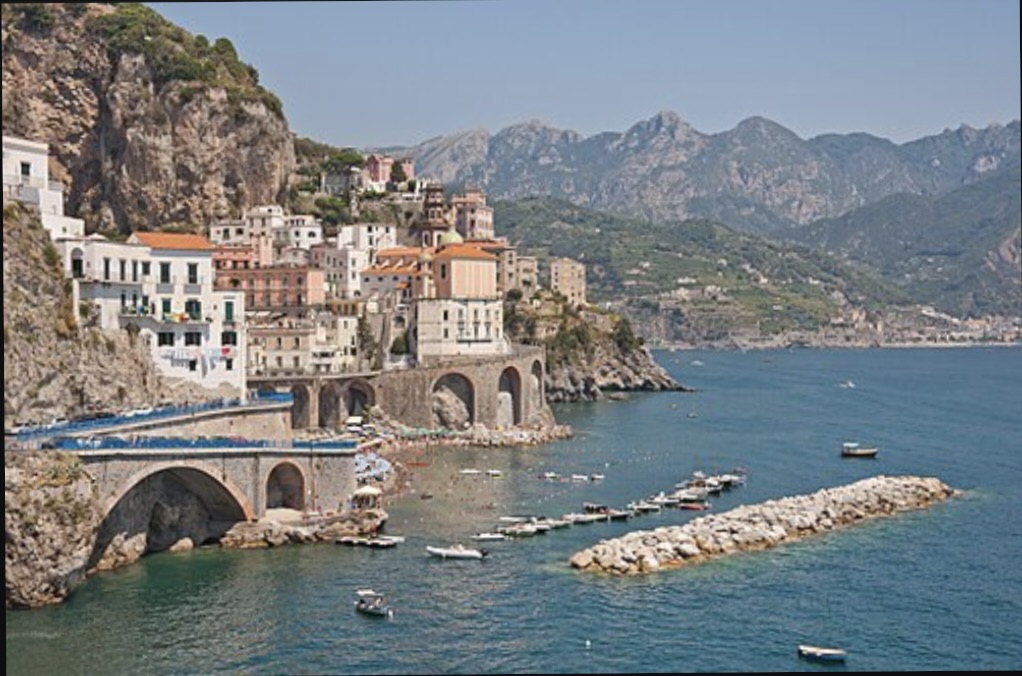
Just beside Amalfi lies Atrani, one of the smallest and most charming towns on the coast.
While Positano is known for its colorful hillside profile and Amalfi for its maritime history, Atrani feels more intimate. Its buildings gather around a central square and a small beach, creating a close-knit village atmosphere.
Atrani has retained much of its traditional structure. Narrow passages, vaulted walkways, staircases, and old houses create a sense of continuity. The town’s compact design reflects a time when daily life took place within walking distance of homes, churches, workshops, and the shore.
The village demonstrates that the Amalfi Coast’s beauty is not limited to grand viewpoints. Sometimes it is found in smaller details: laundry moving in the breeze, worn stone steps, a sunlit wall, or the sound of conversation drifting from a café.
Atrani is a reminder that the coast is not only a scenic attraction. It is also a collection of communities with their own rhythms and personalities.
Ravello: gardens above the clouds
 High above the coast, Ravello offers a different kind of beauty.
While many coastal towns draw the eye toward the sea, Ravello seems to float above it. The town sits on a mountain ridge, surrounded by gardens, terraces, and expansive views across the Mediterranean.
Ravello became a refuge for artists, musicians, writers, and travelers seeking solitude and inspiration. Its elevated position provided both privacy and extraordinary scenery.
Two of its most famous landmarks are Villa Rufolo and Villa Cimbrone.
Villa Rufolo contains gardens, historic architecture, and terraces overlooking the coast. The setting has inspired generations of visitors and artists. Villa Cimbrone is especially famous for the Terrace of Infinity, where a row of classical columns frames one of the most spectacular views in Italy.
Ravello also has a strong connection with music. The Ravello Festival, held in honor of the composer Richard Wagner, reflects the town’s long association with art and creativity.
Here, the landscape seems designed for contemplation. The sea spreads across the horizon, mountains descend toward distant villages, and gardens create quiet spaces where visitors can pause.
The terraces: agriculture carved into the mountains
One of the most remarkable features of the Amalfi Coast is its agricultural landscape.
Because the mountains are steep, farmers created terraces supported by dry-stone walls. These terraces allowed crops to grow on slopes that would otherwise have been too difficult to cultivate.
Lemon groves are among the most distinctive features of the coast. The Amalfi lemon, known locally as the sfusato amalfitano, is large, fragrant, and prized for its flavor.
Lemons are used in desserts, sauces, drinks, preserves, and the famous liqueur limoncello. Their yellow color adds another layer to the coast’s visual identity, contrasting with green leaves, pale stone, and blue sea.
The terraces also support grapes, olives, vegetables, herbs, and other crops. In some areas, vineyards are cultivated on extremely steep slopes where planting and harvesting require patience and physical effort.
These agricultural landscapes are part of the reason the coast was recognized as a UNESCO World Heritage Site. The scenery is not untouched wilderness. It is a carefully maintained relationship between people and difficult terrain.
Every terrace tells a story of adaptation.
Every stone wall represents work.
Every lemon grove reflects a tradition passed from one generation to the next.
Food shaped by the sea and soil
The cuisine of the Amalfi Coast is inseparable from its geography.
The sea provides anchovies, tuna, squid, prawns, mussels, and other seafood. The mountains provide herbs, vegetables, olives, and fruit. Lemons appear in everything from pastries to seafood dishes.
Pasta is often prepared with simple ingredients: tomatoes, garlic, olive oil, basil, seafood, or local vegetables. The strength of the cuisine lies in freshness rather than excessive complexity.
A meal beside the coast might include grilled fish, lemon-seasoned vegetables, handmade pasta, crusty bread, local cheese, and a glass of wine from a nearby hillside vineyard.
Desserts often feature citrus flavors. Lemon cakes, pastries, gelato, and creamy desserts reflect the importance of the region’s fruit-growing traditions.
Food here is not simply fuel. It is a way of expressing place.
To eat on the Amalfi Coast is to taste the relationship between mountain terraces, Mediterranean water, warm sunlight, and generations of local knowledge.
The Path of the Gods
High above the coastline is one of the region’s most famous  walking routes: the Sentiero degli Dei, or Path of theGods.
The trail follows the mountains between the towns of Agerola and Nocelle, offering extraordinary views of the coast and sea. In some places, the path passes through forests and quiet fields. In others, it reaches open cliffs where the entire coastline appears to unfold below.
The name reflects the trail’s atmosphere. On a clear day, it can feel as though the walker is moving above the ordinary world.
The path also reveals a side of the Amalfi Coast that is easy to miss from the main roads. Away from the beaches and busy town centers, the landscape becomes quieter. Terraces, farms, stone walls, and mountain paths show how local people once traveled and worked.
Walking the trail is not only a physical journey. It is a way to understand the relationship between the villages and the mountains.
The coast looks different from above. The towns become part of a larger pattern, connected by cliffs, valleys, paths, and sea.
The sea as a highway
For centuries, the sea was the most practical way to travel along the Amalfi Coast.
The mountains made overland journeys difficult, but boats could move between coastal communities. Fishing, trade, communication, and migration all depended on the Mediterranean.
Even today, the coastline is often best understood from the water. Viewed from a boat, the mountains rise in dramatic layers, villages appear suspended above the shore, and hidden coves become visible beneath the cliffs.
From the sea, it becomes clear how closely the towns are connected to their environment. Their colors, shapes, and locations are determined by the coastline’s curves and the available land.
The water also reveals the changing scale of the region. A road that feels narrow and crowded from inside a vehicle looks like a delicate line from offshore. A village that seems large when walking through its streets appears small against the mountains.
The sea gives the coast perspective.
The influence of artists and writers
The Amalfi Coast has long attracted creative people.
Artists came to paint the light, the cliffs, and the dramatic relationship between land and sea. Writers found inspiration in the region’s beauty, isolation, and ancient history. Musicians were drawn to the atmosphere of Ravello and its gardens.
The coast’s light is one reason it has appealed to painters and photographers. Sunlight changes quickly as it moves across the mountains. Morning brings soft colors and long shadows. Afternoon makes the sea brilliant and the cliffs sharply defined. Evening covers the villages in gold and rose.
The landscape also encourages a particular kind of attention. There is always another viewpoint, another staircase, another curve in the road, another village visible across the water.
The coast does not offer only one grand scene. It offers countless smaller moments.
That is why no photograph, however beautiful, can fully capture it.
Tourism and the modern Amalfi Coast
The Amalfi Coast became increasingly popular during the twentieth century, especially as roads, cars, ferries, and international travel made the region easier to reach.
Tourism brought prosperity and created jobs in hotels, restaurants, transportation, guiding, retail, agriculture, and the arts. It also helped preserve and promote local traditions.
At the same time, popularity created serious challenges.
During the busiest months, roads can become congested. Historic towns face pressure from large crowds. Water, waste, transportation, and housing systems must support both residents and visitors. Coastal habitats and archaeological sites require protection.
The success of the Amalfi Coast depends on responsible tourism. Visitors can help by respecting local communities, supporting small businesses, avoiding litter, using public transportation where possible, following marked paths, and treating historic sites and natural areas with care.
A beautiful place can be damaged by the very attention that makes it famous.
The future of the Amalfi Coast will depend on whether tourism remains connected to preservation rather than consumption.
Why the Amalfi Coast became what it is today
The Amalfi Coast is the result of several forces working together:
- Geology created the cliffs, valleys, caves, and natural harbors.
- The sea connected the region to the Mediterranean world.
- Indigenous and local communities developed ways to live from the land and water.
- The Maritime Republic of Amalfi made the coast a center of trade and navigation.
- Agriculture transformed steep slopes into productive terraces.
- Religion and architecture gave the towns their churches, monasteries, towers, and historic centers.
- Artists and writers helped the world recognize the coast’s beauty.
- Modern tourism turned the region into an international destination.
- UNESCO recognition highlighted its cultural and environmental importance.
- Conservation efforts now seek to protect the landscape for the future.
Without any one of these elements, the coast would be different.
Its beauty is natural, but its character is human.
A place that feels almost imagined
 The Amalfi Coast is often described as a dream, and it is easy to understand why.
The colors seem unusually vivid. The villages appear improbably placed. The mountains seem too steep for houses, gardens, and roads. The sea is so blue that it becomes part of the architecture, visible from windows, terraces, churches, and streets.
But the coast is not a fantasy. Its beauty comes from real history and real work.
Behind every scenic village is a long story of adaptation. Behind every terrace is physical labor. Behind every historic building are generations of families, merchants, sailors, farmers, artists, and religious communities.
The Amalfi Coast is beautiful because nature made it dramatic—but also because people learned how to belong within it.
Final reflection
The Amalfi Coast is one of the most beautiful places on Earth because it brings together everything travelers hope to find in a landscape: mountains, sea, history, culture, food, art, architecture, and human warmth.
It is a place where the past remains visible in the present.
Ancient maritime traditions survive in the towns. Medieval churches rise above modern cafés. Lemon groves continue to cover terraces built generations ago. Boats still move across the same Mediterranean waters that once carried merchants from the Maritime Republic of Amalfi.
The coast has changed, but it has not lost its identity.
Its future will require care. The cliffs must be protected, the terraces maintained, the villages respected, and the pressures of tourism managed thoughtfully.
The Amalfi Coast teaches an important lesson: the most beautiful places are rarely untouched. Their beauty often comes from a long partnership between human beings and the natural world.
Here, stone meets sea, history meets daily life, and every winding road leads toward another view that seems impossible to forget.
Image note: The photographs are linked from Wikimedia Commons and other publicly accessible sources. If you plan to republish this article commercially, confirm each image’s license and attribution requirements on its original source page