


















[et_pb_section fb_built=”1″ _builder_version=”4.27.7″ _module_preset=”default” global_colors_info=”{}”][et_pb_row _builder_version=”4.27.7″ _module_preset=”default”][et_pb_column _builder_version=”4.27.7″ _module_preset=”default” type=”4_4″][et_pb_text _builder_version=”4.27.7″ _module_preset=”default” hover_enabled=”0″ sticky_enabled=”0″]

The night was calm.
A cool spring breeze drifted across the forests of northern Ukraine. In the nearby city of Pripyat, children slept peacefully, unaware that in just a few hours their world would disappear forever.
Apartment lights slowly winked out. Couples returned from late-night walks. Workers prepared for another ordinary shift.
Nothing about the evening of April 25, 1986, hinted that history was about to change.
Then, at 1:23:40 a.m., the impossible happened.
Inside Reactor No.4 at the Chernobyl Nuclear Power Plant, engineers were conducting a safety test. It was supposed to demonstrate what would happen if electrical power was lost. Instead, a chain of critical mistakes, combined with dangerous reactor design flaws, pushed the reactor into an uncontrollable state.
Without warning, two massive explosions tore through the reactor.
The steel and concrete lid weighing nearly 2,000 tonnes blasted into the air. A pillar of fire erupted into the darkness, carrying radioactive debris thousands of feet into the atmosphere. Pieces of glowing graphite rained across the roof of the plant, burning with an eerie light unlike anything firefighters had ever seen.
Many believed they were fighting an ordinary industrial fire.
They were walking into invisible death.
Firefighters rushed to the scene with no knowledge of the radiation surrounding them. They climbed onto rooftops littered with radioactive graphite, their boots crunching over fragments of the reactor’s core. They worked heroically, extinguishing fires that threatened to spread to other reactors.
Within hours, many began suffering severe nausea, dizziness, and burns that no flame could have caused.
Radiation has no smell.
No colour.
No sound.
Yet it was everywhere.
As dawn broke over Pripyat, residents stood on balconies watching the strange blue glow rising above the reactor. Some gathered on bridges to watch the fire from a distance, fascinated by the spectacle. Children played outside. Families carried on with their Saturday morning.
No evacuation order came.
For nearly 36 hours, more than 45,000 people remained in the city while radioctive particles settled onto streets, rooftops, playgrounds, and clothing.
When buses finally arrived on the afternoon of April 27, loudspeakers instructed residents to pack only essentials. They were told they would return in a few days.
Most never came back.
Pripyat became a city frozen in time.
Meanwhile, the radioactive cloud ignored national borders.
It drifted silently across Belarus, Russia, Scandinavia, and much of Europe. Days later, elevated radiation levels detected at a nuclear power plant in Sweden alerted the world that something catastrophic had happened inside the Soviet Union.
Only then did the full scale of the disaster begin to emerge.
Thousands of soldiers, firefighters, miners, engineers, and volunteers, later known as the Liquidators, were sent to contain the catastrophe. Many worked with minimal protection, clearing radioactive debris by hand after machines failed in the intense radiation.
Helicopter crews flew directly above the exposed reactor, dropping sand, boron, lead, and clay in desperate attempts to reduce the release of radioactive material.
Their efforts came at an enormous human cost.
In the months that followed, the damaged reactor was enclosed within a massive concrete and steel structure known as the Sarcophagus, which was built under the extraordinary conditions to contain the remaining radioactive material.
Decades later, a larger steel enclosure would be placed over the sarcophagus to further secure the site for generations to come.
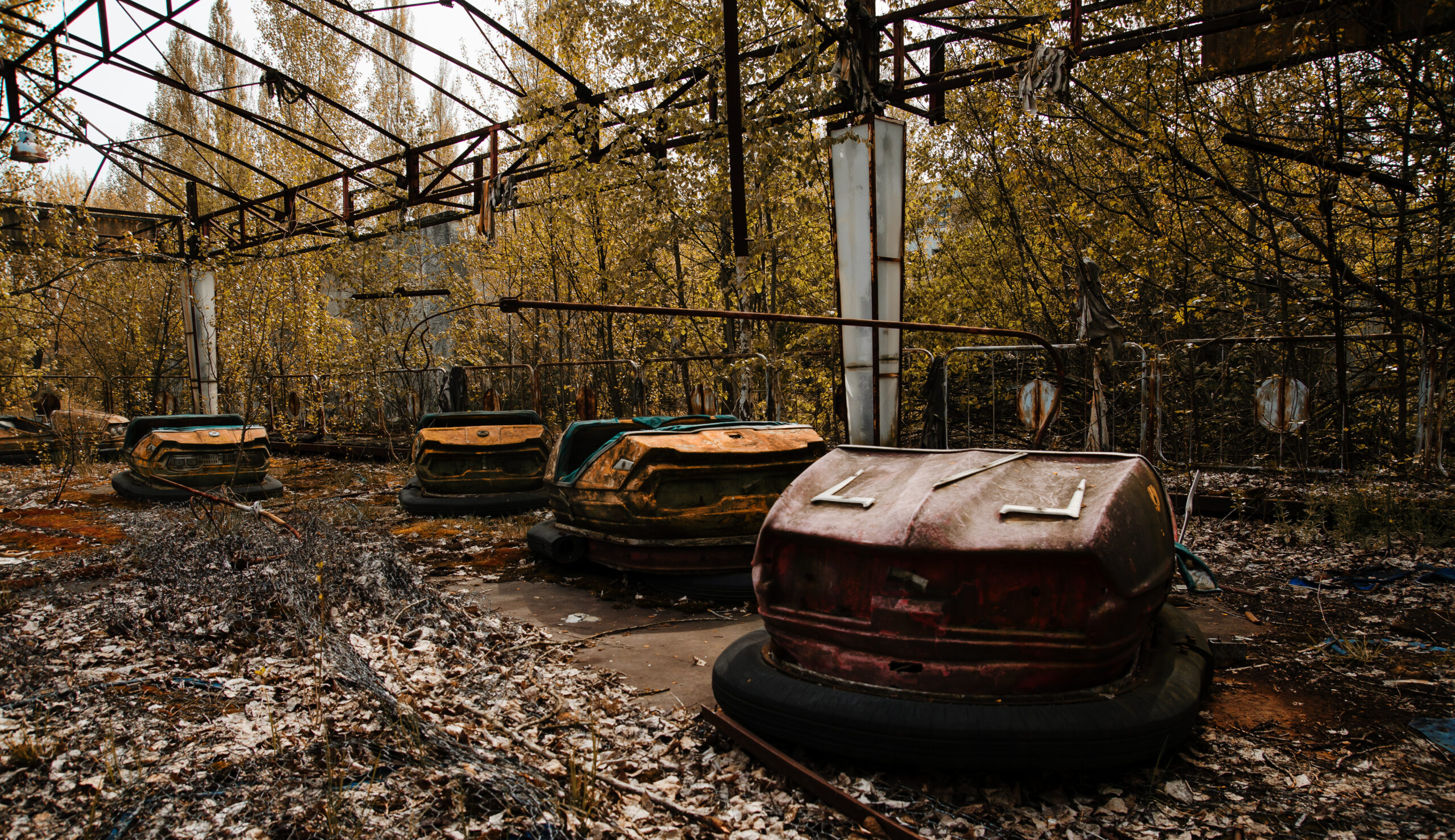
Today, apartment blocks slowly crumble beneath encroaching forests.
It is one of the most haunting landscapes on Earth, not because of what can be seen, but beacuse of what cannot.
Chernobyl was more than a nuclear accident.
It exposed the devastating consequences of human error, flawed engineering, and delayed communication during a crisis. It reshaped international nuclear safety standards, altered the course of Soviet history, and left a legacy that continues to influence energy policy around the world.
More than four decades later, the silence remains.
[/et_pb_text][/et_pb_column][/et_pb_row][/et_pb_section][et_pb_section fb_built=”1″ _builder_version=”4.27.7″ _module_preset=”default” global_colors_info=”{}”][et_pb_row _builder_version=”4.27.7″ _module_preset=”default” global_colors_info=”{}”][et_pb_column type=”4_4″ _builder_version=”4.27.7″ _module_preset=”default” global_colors_info=”{}”][et_pb_image src=”https://skylinevistashots.com/wp-content/uploads/2026/07/image-1.jpeg” _builder_version=”4.27.7″ _module_preset=”default” global_colors_info=”{}”][/et_pb_image][/et_pb_column][/et_pb_row][/et_pb_section]